



Climate alarmists typically contend that in response to global warming, both droughts and floods become more frequent and severe. It is therefore important to determine if long-term precipitation data from various places throughout the world provide any evidence for this phenomenon, which should be evident -- if the climate-alarmist contention is true -- over the period of time when the planet transited from the coldest interval of the current interglacial period (the Little Ice Age) to the end of the 20th century, by which time they claim the earth had warmed at a rate and to a level that was unprecedented over the past one to two millennia. Herein we thus explore such real-world data as it pertains to Asia, starting with a review of what researchers have found for China.
Utilizing a multi-model approach developed previously (Wang et al., 2009), Wang et al. (2011) employed four physically-based land surface hydrology models that were driven by an observation-based three-hourly meteorological data set to simulate soil moisture over China for the period 1950-2006, deriving monthly values of total column soil moisture from which they calculated agricultural drought severities and durations. In doing so, the authors report that "for drought areas greater than 150,000 km2 and durations longer than three months, a total of 76 droughts were identified," and they say that "regions with downward trends were larger than those with upward trends (37% versus 26% of the land area)," implying that "over the period of analysis, the country has become slightly drier in terms of soil moisture." But are such findings proof of a CO2-induced temperature link? And do they imply an increase in future drought?
In a word, no. As demonstrated in each of the remaining studies examined in this review, any suggestion of a link between drought and global warming is unique to this study only (perhaps because Wang et al.'s drought calculations are derived from models simulating soil moisture, as opposed to measuring it). And with respect to the future, Wang et al. themselves state that "climate models project that a warmer and moister atmosphere in the future will actually lead to an enhancement of the circulation strength and precipitation of the summer monsoon over most of China (e.g., Sun and Ding, 2010) that will offset enhanced drying due to increased atmospheric evaporative demand in a warmer world (Sheffield and Wood, 2008)." Also providing some "worry relief" in this regard are the contemporary findings of Tao and Zhang (2011), who -- using the Lund-Potsdam-Jena Dynamic Global Vegetation Model -- concluded that the net effect of physiological and structural vegetation responses to expected increases in the air's CO2 content will lead to "a decrease in mean evapotranspiration, as well as an increase in mean soil moisture and runoff across China's terrestrial ecosystem in the 21st century," which should act to lessen, or even offset, the "slightly drier" soil moisture conditions observed by Wang et al.
Moving on to other studies examining drought trends in Asia - and China in particular - Paulsen et al. (2003) employed high-resolution stalagmite records of δ13C and δ18O from Buddha Cave "to infer changes in climate in central China for the last 1270 years in terms of warmer, colder, wetter and drier conditions." Among the climatic episodes evident in their data were "those corresponding to the Medieval Warm Period, Little Ice Age and 20th-century warming, lending support to the global extent of these events." More specifically, their record begins in the depths of the Dark Ages Cold Period, which ends about AD 965 with the commencement of the Medieval Warm Period, which continues to approximately AD 1475, whereupon the Little Ice Age sets in and holds sway until about AD 1825, after which the warming responsible for the Modern Warm Period begins.
With respect to hydrologic balance, the last part of the Dark Ages Cold Period was characterized as wet. It, in turn, was followed by a dry, a wet, and another dry interval in the Medieval Warm Period, which was followed by a wet and a dry interval in the Little Ice Age, and finally a mostly wet but highly moisture-variable Modern Warm Period. Paulsen et al.'s data also reveal a number of other cycles superimposed on the major millennial-scale cycle of temperature and the centennial-scale cycle of moisture, most of which higher-frequency cycles they attribute to solar phenomena, concluding that the summer monsoon over eastern China, which brings the region much of its precipitation, may "be related to solar irradiance."
The significance of this study with respect to the present discussion on drought resides in the fact that the authors' data clearly indicate that Earth's climate is determined by a conglomerate of cycles within cycles, all of which are essentially independent of the air's CO2 concentration; and it demonstrates that the multi-century warm and cold periods of the planet's millennial-scale oscillation of temperature may have both wetter and drier periods embedded within them. Consequently, it can be appreciated that warmth alone is not a sufficient condition for the concomitant occurrence of the dryness associated with drought.
Shedding more light on the issue, Jiang et al. (2005) analyzed historical documents to produce a time series of flood and drought occurrences in eastern China's Yangtze Delta since AD 1000. Their work also revealed that alternating wet and dry episodes occurred throughout this lengthy period; and the data demonstrate that droughts and floods usually occurred in the spring and autumn seasons of the same year, with the most rapid and strongest of these fluctuations occurring during the Little Ice Age (1500-1850), as opposed to the preceding Medieval Warm Period and the following Current Warm Period.
Also working in China's Yangtze Delta region were Zhang et al. (2007), who developed flood and drought histories of the past thousand years based on "local chronicles, old and very comprehensive encyclopedia, historic agricultural registers, and official weather reports," after which "continuous wavelet transform was applied to detect the periodicity and variability of the flood/drought series" -- which they describe as "a powerful way to characterize the frequency, the intensity, the time position, and the duration of variations in a climate data series." In addition, they compared their results with two one-thousand-year temperature histories of the Tibetan Plateau: northeastern Tibet and southern Tibet.
As a result of this effort, Zhang et al. report that during AD 1400-1700 (the coldest portion of their record, corresponding to much of the Little Ice Age), the proxy indicators showed that "annual temperature experienced larger variability (larger standard deviation), and this time interval exactly [italics added] corresponds to the time when the higher and significant wavelet variance occurred." In contrast, they report that during AD 1000-1400 (the warmest portion of their record, corresponding to much of the Medieval Warm Period), relatively stable "climatic changes reconstructed from proxy indicators in Tibet correspond to lower wavelet variance of flood/drought series in the Yangtze Delta region."
In one final study from China, Zhang et al. (2009) utilized (1) the decadal locust (Locusta migratoria manilensis) abundance data of Ma (1958) for the AD 950s-1950s, (2) the decadal Yangtze Delta flood and drought frequency data of Jiang et al. (2005) for the AD 1000s-1950s, and (3) the decadal mean temperature records of Yang et al. (2002) for the AD 950s-1950s, to perform a wavelet analysis "to shed new light on the causal relationships between locust abundance, floods, droughts and temperature in ancient China." In doing so, the international team of Chinese, French, German and Norwegian researchers found that coolings of 160-170-year intervals dominated climatic variability in China over the past millennium, and that these cooling periods promoted locust plagues by enhancing temperature-associated drought/flood events.
In commenting on their findings, the six scientists say their results suggest that "global warming might not only imply reduced locust plague[s], but also reduced risk of droughts and floods for entire China," noting that these findings "challenge the popular view that global warming necessarily accelerates natural and biological disasters such as drought/flood events and outbreaks of pest insects." Indeed, they say their results are an example of "benign effects of global warming on the regional risk of natural disasters."
Moving north to Mongolia, Davi et al. (2006) employed absolutely dated tree-ring-width chronologies from five sampling sites in the west-central region of the country -- all of them "in or near the Selenge River basin, the largest river in Mongolia" -- to develop a reconstruction of streamflow that extended from 1637 to 1997. Results indicated that, of the ten driest five-year periods of the 360-year record, only one occurred during the 20th century (and that just barely: 1901-1905, sixth driest of the ten extreme periods), while of the ten wettest five-year periods, only two occurred during the 20th century (1990-1994 and 1917-1921, the second and eighth wettest of the ten extreme periods, respectively). Consequently, as Davi et al. describe the situation, "there is much wider variation in the long-term tree-ring record than in the limited record of measured precipitation," such that over the course of the 20th century, which climate alarmists describe as having experienced a warming that was unprecedented over the past two millennia, extremes of both dryness and wetness were both less frequent and less severe.
Working nearby, Kalugin et al. (2005) utilized sediment cores from Lake Teletskoye in the Altai Mountains of Southern Siberia to produce a multi-proxy climate record spanning the past 800 years. This record revealed that the regional climate was relatively warm with high terrestrial productivity from AD 1210 to 1380. Thereafter, however, temperatures cooled and productivity dropped, reaching a broad minimum between 1660 and 1700, which interval, in their words, "corresponds to the age range of the well-known Maunder Minimum (1645-1715)" and is "in agreement with the timing of the Little Ice Age in Europe (1560-1850)."
With respect to moisture and precipitation, Kalugin et al. state that the period between 1210 and 1480 was more humid than that of today, while the period between 1480 and 1840 was more arid. In addition, they report three episodes of multi-year drought (1580-1600, 1665-1690 and 1785-1810), which findings are in agreement with other historical data and tree-ring records from the Mongolia-Altai region (Butvilovskii, 1993; Jacoby et al., 1996; Panyushkina et al., 2000). Consequently, this study also proves problematic in supporting the claim that global warming will lead to more frequent and more severe droughts, as all of the major multi-year droughts detected in this study occurred during the cool phase of the 800-year record.
Moving eastward across the continent, Ducic (2005) analyzed observed and reconstructed discharge rates of the Danube River near Orsova, Serbia, over the period 1731-1990, finding that the lowest 5-year discharge value in the pre-instrumental era (period of occurrence: 1831-1835) was practically equal to the lowest 5-year discharge value in the instrumental era (period of occurrence: 1946-1950), and that the driest decade of the entire 260-year period was 1831-1840. What is more, the discharge rate for the last decade of the record (1981-1990), which prior researchers had claimed was anthropogenically-influenced, was found to be "completely inside the limits of the whole series," in Ducic's words, and only slightly (0.7%) less than the 260-year mean. As a result, Ducic concluded that "modern discharge fluctuations do not point to [a] dominant anthropogenic influence." In fact, Ducic's correlative analysis suggests that the detected cyclicity in the record could "point to the domination of the influence of solar activity."
In another study, Kim et al. (2009) developed a 200-year history of precipitation measured at Seoul, Korea (1807 to 2006), along with the results of a number of "progressive methods for assessing drought severity from diverse points of view," starting with (1) the Effective Drought Index (EDI) developed by Byun and Wilhite (1999), which Kim et al. describe as "an intensive measure that considers daily water accumulation with a weighting function for time passage," (2) a Corrected EDI that "considers the rapid runoff of water resources after heavy rainfall" (CEDI), (3) an Accumulated EDI that "considers the drought severity and duration of individual drought events" (AEDI), and (4) a Year-accumulated negative EDI "representing annual drought severity" (YAEDI).
The researchers' precipitation history and two of their drought severity histories are presented, in that order, in the two figures below.
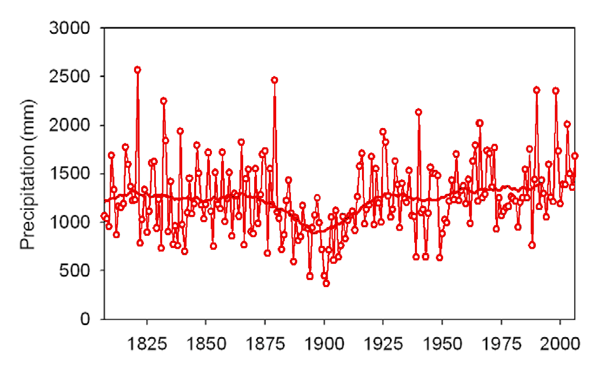
Figure 1. Annual precipitation history at Seoul, Korea, where the solid line represents a 30-year moving-average. Adapted from Kim et al. (2009).
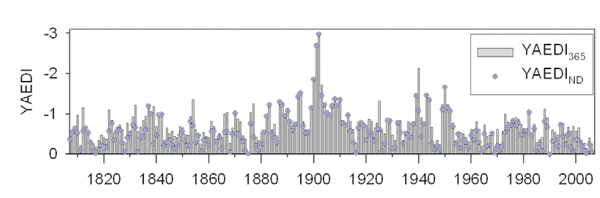
Figure 2. Annual "dryness" history at Seoul, Korea, represented by YAEDI365 (Sum of daily negative EDI values divided by 365, represented by bars) and YAEDIND (Sum of daily negative EDI values divided by total days of negative EDI, represented by open circles). Adapted from Kim et al. (2009).
In viewing the results depicted in Figures 1 and 2 above, it is clear that the only major multi-year deviation from long-term normalcy is the decadal-scale decrease in precipitation and ensuing drought, which phenomena each achieved their most extreme values (low in the case of precipitation, high in the case of drought) in the vicinity of AD 1900, well before the 20th century rise in atmospheric CO2 and global temperatures. The significant post-Little Ice Age warming of the planet, therefore, had essentially no effect at all on the long-term histories of either precipitation or drought at Seoul, Korea, which observation adds to the growing body of such findings from all over Asia.
In still another example of the disconnect between global warming and claims of increasing drought, Touchan et al. (2003) developed two reconstructions of spring precipitation for southwestern Turkey from tree-ring width measurements, one of them (1776-1998) based on nine chronologies of Cedrus libani, Juniperus excelsa, Pinus brutia and Pinus nigra, and the other one (1339-1998) based on three chronologies of Juniperus excelsa. These records, according to them, "show clear evidence of multi-year to decadal variations in spring precipitation." Nevertheless, they report that "dry periods of 1-2 years were well distributed throughout the record" and that the same was largely true of similar wet periods. With respect to more extreme events, the period preceding the Industrial Revolution stood out. They note, for example, that "all of the wettest 5-year periods occurred prior to 1756." Likewise, the longest period of reconstructed spring drought was the four-year period 1476-79, while the single driest spring was 1746.
Moving to India, Sinha et al. (2007) derived a nearly annually-resolved record of Indian summer monsoon (ISM) rainfall variations for the core monsoon region of India that stretches from AD 600 to 1500 based on a 230Th-dated stalagmite oxygen isotope record from Dandak Cave, which is located at 19°00'N, 82°00'E. This work revealed that "the short instrumental record of ISM underestimates the magnitude of monsoon rainfall variability," and they state that "nearly every major famine in India [over the period of their study] coincided with a period of reduced monsoon rainfall as reflected in the Dandak δ18O record," noting two particularly devastating famines that "occurred at the beginning of the Little Ice Age during the longest duration and most severe ISM weakening of [their] reconstruction." In addition, they state that "ISM reconstructions from Arabian Sea marine sediments (Agnihotri et al., 2002; Gupta et al., 2003; von Rad et al., 1999), stalagmite δ18O records from Oman and Yemen (Burns et al., 2002; Fleitmann et al., 2007) and a pollen record from the western Himalaya (Phadtare and Pant, 2006) also indicate a weaker monsoon during the Little Ice Age and a relatively stronger monsoon during the Medieval Warm Period." As a result, the eight researchers note that "since the end of the Little Ice Age, ca 1850 AD, the human population in the Indian monsoon region has increased from about 200 million to over 1 billion," and that "a recurrence of weaker intervals of ISM comparable to those inferred in our record would have serious implications to human health and economic sustainability in the region," which suggests that the Current Warm Period the Earth is experiencing is something for which a sizable fraction of the planet's population should be very thankful.
Further exploring the issue of drought in India, was Sinha et al. (2011), who writing as background for their study warn that the return of a severe drought to the region could pose "a particular serious threat for the predominantly agrarian-based societies of monsoon Asia, where the lives of billions of people are tightly intertwined with the annual monsoon cycle." And as a result of such concern, the group of eight researchers, hailing from China, Germany and the United States, review in great detail what is known about the history of the monsoon, relying heavily on the work of Sinha et al. (2007) and Berkelhammer et al. (2010).
Based on their review, Sinha et al. (2011) state that "proxy reconstructions of precipitation from central India, north-central China [Zhang et al., 2008], and southern Vietnam [Buckley et al., 2010] reveal a series of monsoon droughts during the mid 14th-15th centuries that each lasted for several years to decades," and they say that "these monsoon megadroughts have no analog during the instrumental period." They also note that "emerging tree ring-based reconstructions of monsoon variability from SE Asia (Buckley et al., 2007; Sano et al., 2009) and India (Borgaonkar et al., 2010) suggest that the mid 14th-15th century megadroughts were the first in a series of spatially widespread megadroughts that occurred during the Little Ice Age," and that they "appear to have played a major role in shaping significant regional societal changes at that time." Among these upheavals, they make special mention of "famines and significant political reorganization within India (Dando, 1980; Pant et al., 1993; Maharatna, 1996), the collapse of the Yuan dynasty in China (Zhang et al., 2008), the Rajarata civilization in Sri Lanka (Indrapala, 1971), and the Khmer civilization of Angkor Wat fame in Cambodia (Buckley et al., 2010)," noting that the evidence suggests that "monsoon megadroughts may have played a major contributing role in shaping these societal changes."
In one final study that covers the whole of Asia, Cluis and Laberge (2001) analyzed streamflow records stored in the databank of the Global Runoff Data Center at the Federal Institute of Hydrology in Koblenz (Germany) to see if there were any changes in Asian river runoff of the type predicted by the IPCC to lead to more frequent and more severe drought. More specifically, their study was based on the streamflow histories of 78 rivers said to be "geographically distributed throughout the whole Asia-Pacific region." The mean start and end dates of these series were 1936 +/- 5 years and 1988 +/- 1 year, respectively, representing an approximate half-century time span.
Results of their analysis indicated that in the case of the annual minimum discharges of these rivers, which are the ones associated with drought, 53% of them were unchanged over the period of the study; and where there were trends, 62% of them were upward, indicative of a growing likelihood of both less frequent and less severe drought.
In considering the findings of all of the studies presented above, it can be concluded that the preponderance of real-world evidence from Asia does not support the climate-alarmist claim that global warming leads to the occurrence of either more frequent or more severe droughts. In fact, and in near unanimity, just the opposite is found to be the case: global warming leads to less frequent and less severe drought.
References
Agnihotri, R., Dutta, K., Bhushan, R. and Somayajulu, B.L.K. 2002. Evidence for solar forcing on the Indian monsoon during the last millennium. Earth and Planetary Science Letters 198: 521-527.
Berkelhammer, M., Sinha, A., Mudelsee, M., and Cannariato, K.G. 2010. Persistent multidecadal power in the Indian summer monsoon. Earth and Planetary Science Letters 290: 166-172.
Borgaonkar, H.P., Sikdera, A.B., Rama, S. and Panta, G.B. 2010. El Niño and related monsoon drought signals in 523-year-long ring width records of teak (Tectona grandis L.F.) trees from south India. Palaeogeography, Palaeoclimatology, Palaeoecology 285: 74-84.
Buckley, B.M., Anchukaitis, K.J., Penny, D., Fletcher, R., Cook, E.R., Sano, M., Nam, L.C., Wichienkeeo, A., Minh, T.T. and Hong, T.M. 2010. Climate as a contributing factor in the demise of Angkor, Cambodia. Proceedings of the National Academy of Sciences USA 107: 6748-6752.
Buckley, B.M., Palakit, K., Duangsathaporn, K., Sanguantham, P. and Prasomsin, P. 2007. Decadal scale droughts over northwestern Thailand over the past 448 years: links to the tropical Pacific and Indian Ocean sectors. Climate Dynamics 29: 63-71.
Burns, S.J., Fleitmann, D., Mudelsee, M., Neff, U., Matter, A. and Mangini, A. 2002. A 780-year annually resolved record of Indian Ocean monsoon precipitation from a speleothem from south Oman. Journal of Geophysical Research 107: 10.1029/2001JD001281.
Butvilovskii, V.V. 1993. Paleogeography of the Late Glacial and Holocene on Altai. Tomsk University, Tomsk.
Byun, H.R. and Wilhite, D.A. 1999. Objective quantification of drought severity and duration. Journal of Climate 12: 2747-2756.
Cluis, D. and Laberge, C. 2001. Climate change and trend detection in selected rivers within the Asia-Pacific region. Water International 26: 411-424.
Dando, W.A. 1980. The Geography of Famine. John Wiley, New York, New York, USA, p. 209.
Davi, N.K., Jacoby, G.C., Curtis, A.E. and Baatarbileg, N. 2006. Extension of drought records for central Asia using tree rings: West-Central Mongolia. Journal of Climate 19: 288-299.
Ducic, V. 2005. Reconstruction of the Danube discharge on hydrological station Orsova in pre-instrumental period: Possible causes of fluctuations. Edition Physical Geography of Serbia 2: 79-100.
Fleitmann, D., Burns, S.J., Mangini, A., Mudelsee, M., Kramers, J., Neff, U., Al-Subbary, A.A., Buettner, A., Hippler, D. and Matter, A. 2007. Holocene ITCZ and Indian monsoon dynamics recorded in stalagmites from Oman and Yemen (Socotra). Quaternary Science Reviews 26: 170-188.
Gupta, A.K., Anderson, D.M. and Overpeck, J.T. 2003. Abrupt changes in the Asian southwest monsoon during the Holocene and their links to the North Atlantic Ocean. Nature 421: 354-356.
Indrapala, K. 1971. The Collapse of the Rajarata Civilization and the Drift to the Southwest. University of Ceylon Press.
Jacoby, G.C., D'Arrigo, R.D. and Davaajatms, T. 1996. Mongolian tree rings and 20th century warming. Science 273: 771-773.
Jiang, T., Zhang, Q., Blender, R. and Fraedrich, K. 2005. Yangtze Delta floods and droughts of the last millennium: Abrupt changes and long term memory. Theoretical and Applied Climatology 82: 131-141.
Kalugin, I., Selegei, V., Goldberg, E. and Seret, G. 2005. Rhythmic fine-grained sediment deposition in Lake Teletskoye, Altai, Siberia, in relation to regional climate change. Quaternary International 136: 5-13.
Kim, D.-W., Byun, H.-R. and Choi, K.-S. 2009. Evaluation, modification, and application of the Effective Drought Index to 200-Year drought climatology of Seoul, Korea. Journal of Hydrology 378: 1-12.
Ma, S. 1958. The population dynamics of the oriental migratory locust (Locusta migratoria manilensis Meyen) in China. Acta Entomologica Sinica 8: 1-40.
Maharatna, A. 1996. The Demography of Famines: An Indian Historical Perspective. Oxford University Press, Delhi, India, p. 317.
Pant, G.B., Rupa-Kumar, K.N., Sontakke, A. and Borgaonkar, H.P. 1993. Climate variability over India on century and longer time scales. In: Keshavamurty, R.N. and Joshi, P.C. (Eds.). Tropical Meteorology. Tata McGraw-Hill, New Delhi, India, pp. 149-158.
Panyushkina, I.P., Adamenko, M.F., Ovchinnikov, D.V. 2000. Dendroclimatic net over Altai Mountains as a base for numerical paleogeographic reconstruction of climate with high time resolution. In: Problems of Climatic Reconstructions in Pliestocene and Holocene 2. Institute of Archaeology and Ethnography, Novosibirsk, pp. 413-419.
Paulsen, D.E., Li, H.-C. and Ku, T.-L. 2003. Climate variability in central China over the last 1270 years revealed by high-resolution stalagmite records. Quaternary Science Reviews 22: 691-701.
Phadtare, N.R. and Pant, R.K. 2006. A century-scale pollen record of vegetation and climate history during the past 3500 years in the Pinder Valley, Kumaon Higher Himalaya, India. Journal of the Geological Society of India 68: 495-506.
Sano, M., Buckley, B.M. and Sweda, T. 2009. Tree-ring based hydroclimate reconstruction over northern Vietnam from Fokienia hodginsii: eighteenth century mega-drought and tropical Pacific influence. Climate Dynamics 33: 331-340.
Sheffield, J. and Wood, E.F. 2008. Projected changes in drought occurrence under future global warming from multi-model, multi-scenario, IPCC AR4 simulations. Climate Dynamics 31: 79-105.
Sinha, A., Cannariato, K.G., Stott, L.D., Cheng, H., Edwards, R.L., Yadava, M.G., Ramesh, R. and Singh, I.B. 2007. A 900-year (600 to 1500 A.D.) record of the Indian summer monsoon precipitation from the core monsoon zone of India. Geophysical Research Letters 34: 10.1029/2007GL030431.
Sinha, A., Stott, L., Berkelhammer, M., Cheng, H., Edwards, R.L., Buckley, B., Aldenderfer, M. and Mudelsee, M. 2011. A global context for megadroughts in monsoon Asia during the past millennium. Quaternary Science Reviews 30: 47-62.
Sun, Y. and Ding, Y.-H. 2010. A projection of future changes in summer precipitation and monsoon in East Asia. Science in China Series D: Earth Sciences 53: 284-300.
Tao, F. and Zhang, Z. 2011. Dynamic response of terrestrial hydrological cycles and plant water stress to climate change in China. Journal of Hydrometeorology 12: 371-393.
Touchan, R., Garfin, G.M., Meko, D.M., Funkhouser, G., Erkan, N., Hughes, M.K. and Wallin, B.S. 2003. Preliminary reconstructions of spring precipitation in southwestern Turkey from tree-ring width. International Journal of Climatology 23: 157-171.
von Rad, U., Michels, K.H., Schulz, H., Berger, W.H. and Sirocko, F. 1999. A 5000-yr record of climate change in varved sediments from the oxygen minimum zone off Pakistan, northeastern Arabian Sea. Quaternary Research 51: 39-53.
Wang, A., Bohn, T.J., Mahanama, S.P., Koster, R.D. and Lettenmaier, D.P. 2009. Multimodel ensemble reconstruction of drought over the continental United States. Journal of Climate 22: 2694-2712.
Wang, A., Lettenmaier, D.P. and Sheffield, J. 2011. Soil moisture drought in China, 1950-2006. Journal of Climate 24: 3257-3271.
Yang, B., Brauning, A., Johnson, K.R. and Yafeng, S. 2002. Temperature variation in China during the last two millennia. Geophysical Research Letters 29: 10.1029/2001GL014485.
Zhang, P.Z., Cheng, H., Edwards, R.L., Chen, F.H., Wang, Y.J., Yang, X.L., Liu, J., Tan, M., Wang, X.F., Liu, J.H., An, C.L., Dai, Z.B., Zhou, J., Zhang, D.Z., Jia, J.H., Jin, L.Y. and Johnson, K.R. 2008. A test of climate, sun, and culture relationships from an 1810-year Chinese cave record. Science 322: 940-942.
Zhang, Q., Chen, J. and Becker, S. 2007. Flood/drought change of last millennium in the Yangtze Delta and its possible connections with Tibetan climatic changes. Global and Planetary Change 57: 213-221.
Zhang, Z., Cazelles, B., Tian, H., Stige, L.C., Brauning, A. and Stenseth, N.C. 2009. Periodic temperature-associated drought/flood drives locust plagues in China. Proceedings of the Royal Society B 276: 823-831.
Last updated 8 January 2013