




Climate alarmists hotly contend that the degree of global warmth experienced over the latter part of the 20th century was greater than that experienced at any other time over the past two millennia, as exemplified by the paper of Mann and Jones (2003). And why do they promote this scenario so fervently? They do it because this contention helps to cement their claim that the "unprecedented" temperatures of the past few decades were caused by the historical increase in the air's CO2 content. Hence, they cannot tolerate the thought that the Medieval Warm Period of a thousand years ago could have been as warm as, or even warmer than, it has been recently, since there was so much less CO2 in the air at that time than there is now. Likewise, they are equally loath to admit that the temperatures of the Roman Warm Period of two thousand years ago may also have rivaled, or exceeded, those of the recent past, since the atmospheric CO2 concentrations of that still earlier era were also much lower than those of today. As a result, climate alarmists rarely even speak of the Roman Warm Period. In addition, they refuse to entertain the possibility that both of these prior warm epochs were global in extent, claiming instead -- especially with respect to the Medieval Warm Period of which they do speak somewhat, albeit disparagingly -- that it was a purely local phenomenon restricted to lands surrounding the North Atlantic Ocean. In this summary, therefore, we examine these contentions as they pertain to the Roman Warm Period on the other side of the Northern Hemisphere in Asia.
We begin with the study of Ma et al. (2003), who worked with a stalagmite from Jingdong Cave about 90 km northeast of Beijing, China, assessing the climatic history of the past 3000 years at 100-year intervals on the basis of δ18O data, Mg/Sr ratios, and the solid-liquid distribution coefficient of Mg. Between 200 and 500 years ago, they report that "air temperature was about 1.2°C lower than that of the present, corresponding to the Little Ice Age in Europe." Earlier, between AD 700 and 1000, there had been an equally aberrant but warm period that peaked at about AD 900, which they say "corresponded to the Medieval Warm Period in Europe." This period of peak warmth had been preceded by the Dark Ages Cold period that had in turn been preceded by the Roman Warm Period, which in the stalagmite record is best defined by the much colder temperatures that preceded it.
Similar results were obtained by Xu et al. (2002), who studied plant cellulose δ18O variations in cores retrieved from peat deposits at the northeastern edge of the Qinghai-Tibetan Plateau of China. Following the demise of the Roman Warm Period, they observed the existence of three cold events centered at approximately AD 500, 700 and 900, during the Dark Ages Cold Period. Then, from AD 1100-1300, they report that "the δ18O of Hongyuan peat cellulose increased, consistent with that of Jinchuan peat cellulose and corresponding to the 'Medieval Warm Period'." Finally, they note the existence of three cold periods (AD 1370-1400, AD 1550-1610 and AD 1780-1880) that correspond to the Little Ice Age, after which modern warming begins.
In a much broader-based study, Yang et al. (2002) used nine separate proxy climate records derived from peat, lake sediment, ice core, tree ring and other proxy sources to compile a single weighted temperature history for all of China that spanned the past two thousand years. This composite record revealed five distinct climate epochs: a warm stage from AD 0 to 240 (the tail-end of the Roman Warm Period), a cold interval between AD 240 and 800 (the Dark Ages Cold Period), a return to warm conditions from AD 800-1400 (which included the Medieval Warm Period between AD 800 and 1100), a cool interval between 1400 and 1820 (the Little Ice Age), and -- last of all -- the most recent warm regime (the Current Warm Period), which followed the increase in temperature that began in the early 1800s. Of greatest significance, however, was the fact that Yang et al.'s study indicated that the warmest temperatures of the past two millennia were observed in the second and third centuries AD, during the latter stages of the Roman Warm Period.
Another broad-based study of a big chunk of China was published by Ge et al. (2003), who worked with 200 different sets of phenological and meteorological records extracted from a number of historical sources -- many of which are described by Gong and Chen (1980), Man (1990), Sheng (1990) and Wen and Wen (1996) -- to produce a 2000-year history of winter half-year (October to April) temperature for the region of China bounded by latitudes 27 and 40°N and longitudes 107 and 120°E. Based on this record, they report that "from the beginning of the Christian era, climate became cooler at a rate of 0.17°C per century," which correlates well with the fact that this was the period of time when the planet slipped out of the Roman Warm Period and entered into the Dark Ages Cold Period, noting further that "around the AD 490s temperature reached about 1°C lower than that of the present (the 1951-80 mean)."
"Then," as they continue, "temperature entered a warm epoch from the AD 570s to 1310s with a warming trend of 0.04°C per century; the peak warming was about 0.3-0.6°C higher than present for 30-year periods, but over 0.9°C warmer on a 10-year basis." This finding pretty much speaks for itself: during the Medieval Warm Period, this large chunk of China was warmer than it has ever been in modern times over a similar span of years.
"After the AD 1310s," Ge et al. determined that "temperature decreased rapidly at a rate of 0.10°C per century; the mean temperatures of the four cold troughs were 0.6-0.9°C lower than the present, with the coldest value 1.1°C lower." This, of course, was the Little Ice Age, from which the world appears to still be in processes of recovering. In this regard, they also note that "temperature has been rising rapidly during the twentieth century, especially for the period 1981-99, and the mean temperature is now 0.5°C higher than for 1951-80." Nevertheless, Ge et al. report that temperatures during the Medieval Warm Period rose higher still, and for several 10- and 30-year periods.
In another regional study of a second "big chunk of China," Bao et al. (2003) utilized proxy climate records (ice-core δ18O, peat-cellulose δ18O, tree-ring widths, tree-ring stable carbon isotopes, total organic carbon, lake water temperatures, glacier fluctuations, ice-core CH4, magnetic parameters, pollen assemblages and sedimentary pigments) obtained from twenty previously-published studies to derive a 2000-year temperature history of the Tibetan Plateau, after first developing similar temperature histories for its northeastern, southern and western sections. So what did they find?
The temperature histories of the three parts of the Tibetan Plateau were all significantly different from each other. In each case, however, they had one important thing in common: there was more than one prior 50-year period when the mean temperature of each of them was warmer than it was over the most recent 50-year period. In the case of the northeastern sector of the Tibetan Plateau, these maximum-warmth intervals occurred during the Medieval Warm Period; while in the case of the western sector, they occurred near the end of the Roman Warm Period. In the case of the southern sector, however, they occurred during both warm periods. Hence, for all three portions of the Tibetan Plateau, there has been nothing unusual or unnatural about their most recent warm temperatures.
With respect to the entire Tibetan Plateau, the story is pretty much the same: there has been nothing extraordinary about the recent past. For the whole region, however, there was only one prior 50-year period when temperatures were warmer than they were over the most recent 50-year period; and that interval occurred near the end of the Roman Warm Period, some 1850 years ago.
Another important contribution to the story of the Roman Warm Period in Asia comes from Bao et al. (2004), who collected and analyzed various proxy climate data derived from ice cores, tree rings, river and lake sediments, lake terraces and paleosols, as well as historical documents, which enabled them to determine the climatic state of northwest China during the Western and Eastern Han Dynasties (206 BC-AD 220) relative to that of the past two millennia. As they describe it, their analysis revealed "strong evidence for a relatively warm and humid period in northwest China between 2.2 and 1.8 kyr BP," during the same time interval as the Roman Warm Period. In fact, they determined that this period experienced higher temperatures than those of today. What is more, they report that "the warm-wet climate period during 2.2-1.8 kyr BP also occurred in central and east China, after [which] temperatures decreased rapidly (Zhu, 1973; Hameed and Gong, 1993; Yan et al., 1991, 1993; Shi and Zhang, 1996; Ge et al., 2002)," noting additionally that historical records report that "an abrupt climate change from warmer and wetter to cooler and drier conditions occurred around AD 280 (Zhang et al., 1994)." In addition, they state that "three alternate China-wide temperature composites covering the last 2000 years display an obvious warm stage in 0-240 AD (Yang et al., 2002)," and that "according to a 2650-year warm-season temperature reconstruction from a stalagmite from Shihua Cave of Beijing (Tan et al., 2003), the temperatures during 2.1-1.8 ka BP were basically above the average of the entire temperature series."
Rounding out their discussion of their findings, Bao et al. state that "the warm and moist conditions during the Western and Eastern Han Dynasties [i.e., the Roman Warm Period] might have been responsible for the large-scale agricultural production and the local socioeconomic boom that is documented by the occurrence of the famous ruin groups of Loulan, Niya, and Keriya." Citing the existence of plant remains such as walnuts, rice, barley, millet and wheat grains found in the area, they also indicate that the water and temperature conditions of the Roman Warm Period in these parts of Asia "were suitable for rice cultivation and much better than today."
Feng and Hu (2005) also derived decadal surface air temperatures for the last two millennia from ice core and tree-ring data acquired at five locations on the Tibetan Plateau. Their work revealed the late 20th century to have been the warmest period in the past two millennia at two of the sites (Dasuopu, ice core; Dunde, ice core); but such was not the case at the other three sites (Dulan, tree ring; South Tibetan Plateau, tree ring; Guilya, ice core). At Guilya, for example, the data indicated it was significantly warmer than it was in the final two decades of the 20th century for most of the first two centuries of the record, which comprised the latter part of the Roman Warm Period. On the South Tibetan Plateau it was also significantly warmer over another full century near the start of the record; while at Dulan it was significantly warmer for the same portion of the Roman Warm Period plus two near-century-long portions of the Medieval Warm Period.
Working with two Porites corals off the coast of the Leizhou Peninsula in the northern South China Sea, Wei et al. (2004) measured high-resolution Sr/Ca ratios using inductively coupled plasma atomic spectrometry, while their ages were determined via U-Th dating. The transfer function relating the Sr/Ca ratio to temperature was established on a modern Porites lutea coral by calibrating against sea surface temperatures (SSTs) measured from 1989 to 2000 at the nearby Haikou Meteorological Station. By these means one of the two coral sections was dated to AD 489-500 in the middle of the Dark Ages Cold Period, while the other was dated to 539-530 BC in the middle of the Roman Warm Period; and from the Dark Ages Cold Period portion of the coral record, Wei et al. determined that the average annual SST was approximately 2.0°C colder than that of the last decade of the 20th century (1989-2000), while from the Roman Warm Period portion of the record they obtained a mean annual temperature that was identical to that of the 1989-2000 period as measured at the Haikou Meteorological Station.
As in the study of Wei et al., Yu et al. (2005) also derived high-resolution Sr/Ca ratios for Porites lutea coral samples taken off the coast of the Leizhou Peninsula and determined their ages by means of U-Th dating, while the transfer function relating the Sr/Ca ratio to temperature was obtained from a modern P. lutea coral in the same location by calibrating the ratio against SSTs measured from 1960 to 2000 at the Haikou Ocean Observatory. This work revealed, in the words of the researchers, that the coral Sr/Ca ratio was "an ideal and reliable thermometer," after which they employed it to learn that a coral sample that was dated to ~541 BC during the Roman Warm Period yielded "a mean of Sr/Ca-SST maxima of 29.3°C and a mean of Sr/Ca-SST minima of 19.5°C, similar to those of the 1990s (the warmest period of the last century)." And in harmony with their findings, Yu et al. say "historic records show that it was relatively warm and wet in China during 800-300 BC (Eastern Zhou Dynasty); and as a graphic corroborating example of these facts, they say "it was so warm during the early Eastern Zhou Dynasty (770-256 BC) that rivers in today's Shangdong province (35-38°N) never froze for the whole winter season in 698, 590, and 545 BC."
About the same time period, Liu et al. (2006) developed a quantitative reconstruction of temperature changes over the past 3500 years based on alkenone distribution patterns in a sediment core retrieved from China's Lake Qinghai (37°N, 100°E), based on the alkenone unsaturation index (Uk37) and its simplified form (Uk'37), which were "calibrated to growth temperature of marine alkenone producers (Prahl et al., 1988)" and "to temperature changes in lacustrine settings on a regional scale (Chu et al., 2005; Zink et al., 2001)." This work indicated that the temperature record based on Uk'37 clearly showed alternating warm and cold periods. They noted, for example, that "periods at 0-200 yr BP, 500-1100 yr BP and 1500-2000 yr BP were relatively warm, which could be related to the 20th-century warm period, the Medieval Warm Period, and the Roman Warm Period." Also, they state that "cold periods at 200-500 yr BP and 1100-1500 yr BP corresponded to the Little Ice Age and the Dark Ages Cold Period." What is more, their plotted data indicate that the peak warmth of the Roman Warm Period exceeded that of the latter part of the 20th century by about 0.4°C, while the peak warmth of the Medieval Warm Period exceeded peak 20th-century warmth by nearly 1°C.
Several other studies conducted throughout Asia during this time frame also found evidence for a millennial-scale oscillation of climate and a significant Roman Warm Period, including those of (1) Ji et al. (2005), who employed reflectance spectroscopy to analyze a sediment core taken from Qinghai Lake, located in the northeastern part of the Qinghai-Tibet Plateau, to obtain a continuous high-resolution proxy record of the Asian monsoon over the prior 18,000 years, (2) Matul et al. (2007), who studied the distributions of different species of siliceous microflora (diatoms), calcareous microfauna (foraminifers) and spore-pollen assemblages found in sediment cores retrieved from 21 sites on the inner shelf of the southern and eastern Laptev Sea, starting from the Lena River delta and moving seaward between about 130 and 134°E and stretching from approximately 71 to 78°N, which cores were acquired by a Russian-French Expedition during the cruise of R/V Yakov Smirnitsky in 1991, and (3) Bhattacharyya et al. (2007), who developed a history of atmospheric warmth and moisture covering the last 1800 years for the region surrounding Paradise Lake -- which is located in the Northeastern Himalaya at approximately 27°30.324'N, 92°06.269'E -- based on pollen and carbon isotopic (δ13C) analyses of a one-meter-long sediment profile they obtained from a pit "dug along the dry bed of the lakeshore," and who identified a "warm and moist climate, similar to the prevailing present-day conditions," around AD 240 -- which would represent the last part of the Roman Warm Period -- as well as another such period that turned out to be "more warmer 1100 yrs BP (around AD 985) corresponding to the Medieval Warm Period."
Last of all, Yang et al. (2009) synthesized proxy records of temperature and precipitation in arid central Asia over the past two thousand years, focusing on the relationship between temperature and precipitation on timescales ranging from annual to centennial. With respect to temperature, they report that "the most striking features are the existence of the Medieval Warm Period (MWP) and the Little Ice Age (LIA)," both of which can readily be seen in the figure below, which also reveals the existence of the earlier Roman Warm Period (RWP) and Dark Ages Cold Period (DACP), as well as what they call "a recent warming into the 20th century," which have we denominated the Current Warm Period (CWP). As for precipitation, the five researchers say that the MWP "corresponded to an anomalously dry period whereas the cold LIA coincided with an extremely wet condition."
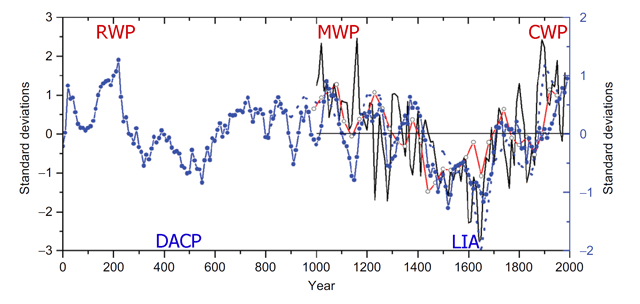
Standardized representations of various reconstructions of the temperature history of arid central Asia. Adapted from Yang et al. (2009).
Once again, therefore, we have a substantial body of evidence for the natural non-CO2-induced millennial-scale cycling of climate that alternately brought Asia, and most of the rest of the world as well, into -- and then out of -- the Roman Warm Period, the Dark Ages Cold Period, the Medieval Warm Period and the Little Ice Age. And this wealth of real-world observations gives us every reason to believe that (1) this natural climatic oscillation is what brought the planet into the Current Warm Period, and that (2) this non-CO2-induced phenomenon will likely bring the world out of our current state of warmth sometime in the not-too-distant future.
References
Bao, Y., Brauning, A. and Yafeng, S. 2003. Late Holocene temperature fluctuations on the Tibetan Plateau. Quaternary Science Reviews 22: 2335-2344.
Bao, Y., Braeuning, A., Yafeng, S. and Fahu, C. 2004. Evidence for a late Holocene warm and humid climate period and environmental characteristics in the arid zones of northwest China during 2.2 ~ 1.8 kyr B.P. Journal of Geophysical Research 109: 10.1029/2003JD003787.
Bhattacharyya, A., Sharma, J., Shah, S.K. and Chaudhary, V. 2007. Climatic changes during the last 1800 yrs BP from Paradise Lake, Sela Pass, Arunachal Pradesh, Northeast Himalaya. Current Science 93: 983-987.
Chu, G., Sun, Q., Li, S., Zheng, M., Jia, X., Lu, C., Liu, J. and Liu, T. 2005. Long-chain alkenone distributions and temperature dependence in lacustrine surface sediments from China. Geochimica et Cosmochimica Acta 69: 4985-5003.
Feng, S. and Hu, Q. 2005. Regulation of Tibetan Plateau heating on variation of Indian summer monsoon in the last two millennia. Geophysical Research Letters 32: 10.1029/2004GL021246.
Ge, Q., Zheng, J., Fang, X., Man, Z., Zhang, X., Zhang, P. and Wang, W.-C. 2003. Winter half-year temperature reconstruction for the middle and lower reaches of the Yellow River and Yangtze River, China, during the past 2000 years. The Holocene 13: 933-940.
Ge, Q., Zheng, J.Y., Man, Z.M., Fang, X.Q. and Zhang, P.Y. 2002. Reconstruction and analysis on the series of winter-half-year temperature changes over the past 2000 years in eastern China. Earth Science Frontiers 9: 169-181.
Gong, G. and Chen, E. 1980. On the variation of the growing season and agriculture. Scientia Atmospherica Sinica 4: 24-29.
Hameed, S. and Gong, G.F. 1993. Temperature variation in China during historical times. In: Climate Change and Its Impact. (Y. Zhang et al., Eds.) China Meteorology, Beijing, China, pp. 57-69.
Ji, J., Shen, J., Balsam, W., Chen, J., Liu, L. and Liu, X. 2005. Asian monsoon oscillations in the northeastern Qinghai-Tibet Plateau since the late glacial as interpreted from visible reflectance of Qinghai Lake sediments. Earth and Planetary Science Letters 233: 61-70.
Liu, Z., Henderson, A.C.G. and Huang, Y. 2006. Alkenone-based reconstruction of late-Holocene surface temperature and salinity changes in Lake Qinghai, China. Geophysical Research Letters 33: 10.1029/2006GL026151.
Ma, Z., Li, H., Xia, M., Ku, T., Peng, Z., Chen, Y. and Zhang, Z. 2003. Paleotemperature changes over the past 3000 years in eastern Beijing, China: A reconstruction based on Mg/Sr records in a stalagmite. Chinese Science Bulletin 48: 395-400.
Man, Z. 1990. Study on the cold/warm stages of Tang Dynasty and the characteristics of each cold/warm stage. Historical Geography 8: 1-15.
Mann, M.E. and Jones, P.D. 2003. Global surface temperatures over the past two millennia. Geophysical Research Letters 30: 10.1029/2003GL017814.
Matul, A.G., Khusid, T.A., Mukhina, V.V., Chekhovskaya, M.P. and Safarova, S.A. 2007. Recent and late Holocene environments on the southeastern shelf of the Laptev Sea as inferred from microfossil data. Oceanology 47: 80-90.
Prahl, F.G., Muehlhausen, L.A. and Zahnle, D.L. 1988. Further evaluation of long-chain alkenones as indicators of paleoceanographic conditions. Geochimica et Cosmochimica Acta 52: 2303-2310.
Sheng, F. 1990. A preliminary exploration of the warmth and coldness in Henan Province in the historical period. Historical Geography 7: 160-170.
Shi, Y. and Zhang, P.Y. (Eds.) Climatic Variation in Historical Time in China. Shandong Science and Technology, Jinan, China.
Wei, G., Yu, K. and Zhao, J. 2004. Sea surface temperature variations recorded on coralline Sr/Ca ratios during Mid-Late Holocene in Leizhou Peninsula. Chinese Science Bulletin 49: 1876-1881.
Wen, H. and Wen, H. 1996. Winter-Half-Year Cold/Warm Change in Historical Period of China. Science Press, Beijing, China.
Xu, H., Hong, Y., Lin, Q., Hong, B., Jiang, H. and Zhu, Y. 2002. Temperature variations in the past 6000 years inferred from δ18O of peat cellulose from Hongyuan, China. Chinese Science Bulletin 47: 1578-1584.
Yan, Z.W., Ye, D.Z. and Wang, C. 1991. Climatic jumps in the flood/drought historical chronology of central China. Climate Dynamics 6: 153-160.
Yan, Z.W., Li, Z.Y. and Wang, C. 1993. Analysis on climatic jump in historical times on decade-century timescales. Sci. Atmos. Sin. 17: 663-672.
Yang, B., Braeuning, A., Johnson, K.R. and Yafeng, S. 2002. General characteristics of temperature variation in China during the last two millennia. Geophysical Research Letters 29: 10.1029/2001GL014485.
Yang, B., Wang, J., Brauning, A., Dong, Z. and Esper, J. 2009. Late Holocene climatic and environmental changes in arid central Asia. Quaternary International 194: 68-78.
Yu, K.-F., Zhao, J.-X, Wei, G.-J., Cheng, X.-R., Chen, T.-G., Felis, T., Wang, P.-X. and Liu, T-.S. 2005. δ18O, Sr/Ca and Mg/Ca records of Porites lutea corals from Leizhou Peninsula, northern South China Sea, and their applicability as paleoclimatic indicators. Palaeogeography, Palaeoclimatology, Palaeoecology 218: 57-73.
Zhang, P.Y., Wang, Z., Liu, X.L. and Zhang, S.H. 1994. Climatic evolution in China during the recent 2000 years. Sci. China Ser. B. 24: 998-1008.
Zhu, K.Z. 1973. A preliminary study on the climatic fluctuations during the last 5,000 years in China. Sci. Sin. 16: 226-256.
Zink, K.G., Leythaeuser, D., Melkonian, M. and Schwark, L. 2001. Temperature dependency of long-chain alkenone distributions in recent to fossil limnic sediments and in lake waters. Geochimica et Cosmochimica Acta 65: 253-265.
Last updated 12 May 2010