




How have earth's lakes responded to what climate alarmists call the unprecedented warming of the past century (relative to the prior 900 years of the past millennium)? In this summary, we review some of the important findings that have been obtained from historical and proxy records of lake temperatures, lake water levels, and lake and stream water chemistry.
We begin with the analysis of Battarbee et al. (2002), who described the results of several studies that employed a variety of palaeolimnological techniques to reconstruct two-century temperature histories of seven remote mountain lakes in Europe, all of which were located above the timber line, had catchments unaffected by human disturbances, and were reasonably far removed from most sources of anthropogenic pollution. Based on their review of the evidence, the nine researchers determined that the seven sites experienced either general cooling or no trend in temperature during the nineteenth century. During the twentieth century, on the other hand, they found that all sites showed a warming trend during the first few decades of the century that peaked between 1930 and 1950. Thereafter, all of the sites depicted cooling, as well as a steep warming over the last ten to twenty years of the record; but for only two of the seven sites did the final warming lead to warmer temperatures than those of the 1930s and 40s. And of the remaining five sites, three of them ended up being cooler than they were prior to mid-century, while two of them ended up exhibiting about equivalent temperatures.
Similar findings were reported by Agusti-Panareda and Thompson (2002), who applied multiple regression analysis to twenty monthly lowland air temperature series for the period 1781-1997, as well as nine monthly upland air temperature series of at least 30 years duration, thereby developing 216-year air temperature histories for eleven remote mountain lakes in Europe, including the seven lakes mentioned in the preceding paragraph. What they found as a result of this exercise was that "during the period 1801-1900, the western European lakes show[ed] no significant trend whereas annual mean air temperatures at the eastern European lakes decrease[d] significantly." For the period 1901-1997, on the other hand, they found there was a warming trend "at all but the Fennoscandian lakes."
Even more interesting is what one learns when the 20 years from 1781-1801 are included in the analysis. In terms of sliding decadal averages, four of the lakes depict net increases in air temperature over the 216-year period, three of them exhibit no net change, and four of them actually depict net cooling. Hence, if close to a dozen European alpine and arctic lakes are no warmer now (on average) than they were during a short period of time at the "beginning of the end" of the Little Ice Age, when atmospheric CO2 concentrations were about 100 ppm less than they are nowadays, there is little reason to presume that a similar period of modern warmth need be caused by the CO2 increase we have experienced in the interim.
In a study of both lakes and rivers in the Baltic region, Yoo and D'Odorico (2002) looked for evidence of temperature change among the dates of annual ice break-up at the termination of the ice season. The results of their analysis demonstrated that a dramatic change in the dates of ice break-up (towards earlier thaw) occurred between the end of the 19th century and the beginning of the 20th century. Describing these changes in more detail, Yoo and D'Odorico wrote that the strongest long-term climatic changes in the Finnish cryophenological records "started in the second half of the 19th century," which is also when the temperature record of Esper et al. (2002) shows the demise of the Little Ice Age to have begun in earnest. In addition, they report that "the shift in the ice break-up dates terminated before 1950 [italics added]," prior to the start of the great bulk of the input of anthropogenic CO2 to the atmosphere, which rapidly accelerated after that point in time.
With respect to changes in the levels of lakes, Nicholson and Yin (2001) detected "two starkly contrasting climatic episodes" in a study of ten major African lakes since the late 1700s. The first episode, which began sometime prior to 1800 and was characteristic of Little Ice Age conditions, was one of "drought and desiccation throughout Africa." This arid episode, which was most extreme during the 1820s and 30s, was accompanied by extremely low lake levels. As the two researchers describe it, "Lake Naivash was reduced to a puddle ... Lake Chad was desiccated ... Lake Malawi was so low that local inhabitants traversed dry land where a deep lake now resides ... Lake Rukwa [was] completely desiccated ... Lake Chilwa, at its southern end, was very low and nearby Lake Chiuta almost dried up." Throughout this harsh period, as they describe it, "intense droughts were ubiquitous." Some, in fact, were "long and severe enough to force the migration of peoples and create warfare among various tribes."
As the Little Ice Age's grip on the world began to loosen in the mid to latter part of the 1800s, however, things began to change for the better for most of the African continent as lake levels began to rise. The two scientists report that "semi-arid regions of Mauritania and Mali experienced agricultural prosperity and abundant harvests; floods of the Niger and Senegal Rivers were continually high; and wheat was grown in and exported from the Niger Bend region." Across the east-west extent of the northern Sahel, in fact, maps and geographical reports described "forests."
As the nineteenth century came to an end and the twentieth century began, there was a slight lowering of lake levels, but nothing like what had occurred a century earlier. Then, in the latter half of the twentieth century, lake levels again began to rise, with the levels of some lakes eventually rivaling high-stands characteristic of the years of transition to the Modern Warm Period.
With respect to the Great Lakes of North America, Larson and Schaetzl (2001) constructed graphs of lake level fluctuations for the period 1915 to 1998, where it can be seen that the lowest levels occurred at about 1926 for Lake Superior, 1962 for Lake Huron-Michigan, 1933 for Lake Erie, and 1934 for Lake Ontario. It is also noteworthy that the longest sustained period of high lake levels for all of the Great Lakes occurred over the last three decades of the 20th century. In addition, lake levels at the end of the record were essentially the same as those at the beginning of the record. Hence, over what climate alarmists claim to be the century that exhibited the greatest warming of the entire past millennium -- which according to them should have resulted in catastrophic consequences for just about everything -- there was no net change in the water level of any of the Great Lakes. In fact, over the last two decades of the record, which radical environmentalists typically describe as having experienced unprecedented warming, the four lakes actually exhibited their greatest stability.
But this was just the beginning of studies of potential climate change impacts on North American Great Lakes. Argyilan and Forman (2003) explored the topic in a bit more detail for the Lake Michigan-Huron system, which they said was "the least affected by engineering modifications that influence lake-level" and, therefore, was concluded by them to be a "sensitive proxy for understanding the relation between climate and water-level fluctuation within the Great Lakes." In doing so, they found that their "analyses of hydrometeorological data from 1920 to 1995 indicate an increase in summer precipitation [and] greater autumn and winter hydrologic inputs into the Lake Michigan-Huron system." More specifically, they determined that "total water input increased from 1920 to 1995 in autumn and winter at rates of 14.6 and 9.3 mm per decade, respectively," with the rise in autumn input being the result of increasing trends in both over-lake precipitation (8.3 mm per decade) and runoff (6.3 mm per decade), with the rise in winter input being the result of a shifting of about 7.5 mm per decade of spring runoff to winter runoff.
In the face of such measurement-derived trends, one would logically have expected the lake level of the Michigan-Huron system to have risen over the period of study, rather than fallen, as climate alarmists imply it should have done in response to the dramatic global warming that they claim occurred over this period. Hence, it should come as no surprise that what the measurements suggested had indeed been the case, i.e., the level of the Lake Michigan-Huron system did rise over the period 1920 to 1995, as is clearly demonstrated by the data presented by Argyilan and Forman -- which were adapted from Quinn (2002) -- as well as the data presented by Larson and Schaetzl (2001).
One year later, Changnon (2004) began the report of his study of Great Lakes water levels by stating that "recent shifts in lake levels [have] led to a major disaster-oriented assessment of the 'record' declines in recent years," adding that certain people had "attributed these to climate change from global warming." In this regard, he made particular mention of the National Geographic Society, which in 2002 published an article entitled "Down the Drain? The Incredible Shrinking Great Lakes" in their flagship publication National Geographic.
In an attempt to establish the truth of the matter, Changnon analyzed "monthly measures of lake levels for Lakes Superior, Erie, and Michigan-Huron [that] were available from the U.S. Army Corps of Engineers for 1861-2001," which data he converted to annual mean levels that he then used to calculate 5-, 15- and 25-year moving averages and associated standard deviations. This work revealed that "the 141-year average lake level distributions for 5-year and longer periods show a U-shaped temporal distribution for Lake Michigan, being highest early (19th Century)," while "the distribution for Lake Erie was also U-shaped but the highest values came in recent years (1970-2001)." Lake Superior, on the other hand, was found to have exhibited "a gradual increase over time from 1861 until about 1950 and a flat trend thereafter." Considered together, the four lakes reached their lowest levels in the 1930s and their highest levels in the period 1982-1987, while lake level variability was highest for all lakes during the period 1923-1938. Consequently, while transiting from the cold of the Little Ice Age to the heat of the Current Warm Period, the water levels of the U.S. Great Lakes have defied the claims of the world's climate alarmists. They have not dropped, nor have they become more erratic. If anything, they have risen and become less erratic.
Fast-forwarding a few more years, McBean and Motiee (2008) began their analysis of the subject by writing that "studies conducted by Cohen (1986, 1990), Sanderson (1987), and Croley (1990, 2004) have found that evaporation would be significantly increased under [IPCC-predicted] climate change scenarios," and that under such circumstances Sanderson and Smith (1990) and Smith and McBean (1993) "predicted twenty to thirty percent increases in potential evaporation and approximately a 15% increase in actual evaporation to occur." As a result of these and other related studies, many researchers have worried, in the words of Larson and Schaetzl (2001), that "increased evaporation under a possible greenhouse-enhanced climate, coupled with even more consumptive use of the Great Lakes waters, could lead to lower lake levels in the near future," which is one of the doom-and-gloom predictions periodically dusted off and paraded before the world by the planet's climate alarmists, such as when National Geographic published their misguided Down-the-Drain piece on the matter.
What McBean and Motiee did, therefore, was use mean monthly and mean annual data series for over-lake air temperature and over-lake precipitation data for the individual Great Lakes, plus flow data for their connecting channels (St. Mary's River, St. Clair River, Niagara River, and St. Lawrence River) to determine long-term (1930-2000) trends in temperature, precipitation and streamflow, using regression analyses and Mann-Kendall statistics. This work revealed that for each of the five Great Lakes, "the best fit line shows a gentle increasing slope" with "an average increase of 0.63°C in the basin," which they say is "less in magnitude than the global climate model predictions." With respect to precipitation and streamflow, they also say they find increasing trends "in all series," with some of them being statistically significant at the 95% level. Last of all, they calculate that if the trends they found for the 1930-2000 time period continue, streamflow at the outlets of Lakes Superior, Huron, Erie and Ontario in the year 2050 will be 7%, 17%, 25% and 25% greater, respectively, than they were in the year 2000. Therefore, and in spite of the climate-alarmist claim that 20th-century warming was "unprecedented" over the past one to two millennia, and that such warming in the Great Lakes region of the Northern Hemisphere should be leading to the massive lakes going "down the drain," real-world data provide no support for this contention, or anything even close to it. In fact, they tend to suggest just the opposite.
Last of all -- with respect to the Great Lakes -- Wiles et al. (2009) compared eighteen temperature sensitive ring-width series of trees from the Gulf of Alaska region with monthly Lake Erie water levels over a common period of 87 years, deriving a good relationship between the ring-width series and mean annual lake levels, after which the four ring-width series found to be most highly correlated with the Lake Erie water levels were used to extend the total length of the lake level history to 265 years. The results of this exercise are presented in the figure below, where it can be seen, as the three scientists state, that "reconstructed extremes have approached but not exceeded the late 20th century high levels." And in the concluding sentence of the abstract of their paper, they reiterate that "the highest lake levels in the reconstruction are found over the past few decades."
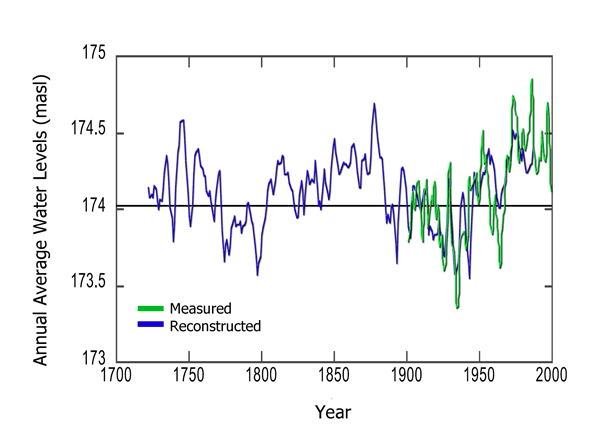
Annual mean water level of Lake Erie vs. time, as directly measured (green line) and as reconstructed (blue line). Adapted from Wiles et al. (2009).
So how did it happen? In discussing their findings, Wiles et al. remark that "the recent higher stands in the 1970s-1990s, and perhaps the steady rise in lake levels over the past 100 years, may be linked to a rise in Gulf of Mexico-derived precipitation that has generally outpaced increased evaporation," and they report that "similar increases in precipitation and humidity have been noted for Lake Michigan (Sellinger et al., 2008) and relative humidity in the general lower Great Lakes regions (LaValle et al., 2000)." Once again, therefore, we have another example of model-based climatic concerns ultimately being replaced with real-world good news.
Shifting from water back to ice, Futter (2003) analyzed data on ice break-up dates and length of the ice-free season for several lakes in Southern Ontario, Canada. However, only one lake had ice break-up dates extending back beyond 1910 (Lake Simcoe, to 1853), and only one had ice-free season data extending back beyond 1971 (also Lake Simcoe, to 1853). Thus, Lake Simcoe was the only lake that had sufficient data for Futter to determine whether trends in lake ice phenology "were due to the end of the Little Ice Age, or to more recent warming."
Breaking the Lake Simcoe data into three comparable time intervals (1853-1899, 1900-1949, 1950-1995), Futter determined that "only the period from 1853-1899 showed a statistically significant trend indicative of warming temperatures in both the ice break up and ice free season series." In fact, he determined that the data from 1900-1949 indicate a cooling trend, and that the data from 1950-1995 "show slight but not statistically significant evidence of warming temperatures." Hence, as we and many others have long contended, the so-called unprecedented warming of the 20th century was likely nothing more than the natural recovery of the world from the chilly conditions of the Little Ice Age. This claim is well supported by the Lake Simcoe ice data, which only show evidence of significant warming over the period from 1853 to 1899. Late 20th-century warming, on the other hand (when greenhouse gas effects should have been most evident), was not statistically significant, which finding pretty much speaks for itself for this particular part of the world: the Little Ice Age was a significantly cooler period than that of the present, while the most recent boost to the Current Warm Period (which may or may not have been due to greenhouse gas emissions) has amounted to very little and is, in fact, insignificant.
For 13 stations located on the shores of Hudson Bay (7) and surrounding nearby lakes (6), Gagnon and Gough (2006) analyzed long-term weekly measurements of ice thickness and associated weather conditions that began and ended, in the mean, in 1963 and 1993, respectively. In doing so, they found that "statistically significant thickening of the ice cover over time was detected on the western side of Hudson Bay, while a slight thinning lacking statistical significance [italics added] was observed on the eastern side." This asymmetry, in their words, was "related to the variability of air temperature, snow depth, and the dates of ice freeze-up and break-up," with "increasing maximum ice thickness at a number of stations" being "correlated to earlier freeze-up due to negative temperature trends in autumn," and with high snow accumulation being associated with low ice thickness, "because the snow cover insulates the ice surface, reducing heat conduction and thereby ice growth."
Noting that their findings were "in contrast to the projections from general circulation models, and to the reduction in sea-ice extent and thickness observed in other regions of the Arctic," Gagnon and Gough stated that "this contradiction must be addressed in regional climate change impact assessments," rather (we would add) than simply being ignored.
Switching gears yet again, Wolfe et al. (2005) conducted a multi-proxy hydro-ecological analysis of northern Alberta's Spruce Island Lake (Canada) in an attempt to assess the impacts of natural variability and anthropogenic change on the hydro-ecology of the region over the past 300 years. More specifically, they attempted to answer the following three questions: (1) Have hydro-ecological conditions in Spruce Island Lake since 1968 (the year in which river flow became regulated from hydroelectric power generation at the headwaters of the Peace River) varied beyond the range of natural variation of the past 300 years? (2) Is there evidence that flow regulation of the Peace River has caused significant changes in hydro-ecological conditions in Spruce Island Lake? (3) How is hydro-ecological variability at Spruce Island Lake related to natural climatic variability and Peace River flood history?
The team's research efforts revealed that hydro-ecological conditions varied substantially over the past 300 years, especially in terms of multi-decadal dry and wet periods. With respect to the three research questions posed above, for example, they found for question #1 that hydro-ecological conditions after 1968 have remained well within the broad range of natural variability observed over the past 300 years, with both "markedly wetter and drier conditions compared to recent decades" having occurred prior to the time of Peace River flow regulation. With respect to question #2, they report that the current drying trend is not the product of Peace River flow regulation, but rather the product of an extended drying period that was initiated in the early to mid-1900s. Lastly, with respect to question #3, Wolfe et al. showed that the multi-proxy hydro-ecological variables they analyzed were well correlated with other reconstructed records of natural climate variability, indicating a likely climatic influence on Spruce Island Lake hydro-ecological conditions over the period of record.
It is important to note, in this regard, that there is nothing unusual about recent trends in the hydro-ecology of the Spruce Island Lake region. The wet and dry conditions of the recent past fall well within the range of prior natural variability and show no fingerprint of anthropogenic global warming. What is more, they even bear no fingerprint of human flow control of the Peace River since 1968, demonstrating, as the six scientists describe it, that "profound changes in hydro-ecological conditions are clearly a natural feature of this ecosystem, independent of human influence or intervention."
Finally, we conclude our summary of lake-related research with the still-different study of Monteith et al. (2007), who introduced their unique work by noting that "several hypotheses have been proposed to explain recent, wide-spread increases in concentrations of dissolved organic carbon (DOC) in the surface waters of glaciated landscapes across eastern North America and northern and central Europe," and who went on to state that "some invoke anthropogenic forcing through mechanisms related to climate change, nitrogen deposition or changes in land use, and by implication suggest that current concentrations and fluxes are without precedent," which hypotheses imply, in their words, that "DOC levels will continue to rise, with unpredictable consequences for the global carbon cycle."
Working with water chemistry data from 522 individual lake and stream sites, which were located within the six countries they studied and which were largely free of local disturbance, Monteith et al. derived trends and mean concentrations of various pertinent parameters for the period 1990-2004. This work revealed -- in the words of the thirteen researchers from the United Kingdom, United States, Norway, Finland, Sweden, Canada and the Czech Republic -- that "rising trends in DOC between 1990 and 2004 can be concisely explained by a simple model based solely on changes in deposition chemistry and catchment acid-sensitivity," thereby demonstrating, as they describe it, that "DOC concentrations have increased in proportion to the rates at which atmospherically deposited anthropogenic sulphur and sea salt have declined," the latter as a result of changes in "meteorological factors that affect Atlantic storminess," but with the former being responsible for more than 85% of the total effect in most of the studied regions. As for the significance of their findings, Monteith et al. say they suggest that "threats of wide-spread destabilization of terrestrial carbon reserves by gradual rises in air temperature or CO2 concentration (Freeman et al., 2001, 2004; Worrall et al., 2003) may have been overstated," and that the DOC fluxes from the regions they studied may simply "be returning to levels more typical of pre-industrial times."
In closing, we note that the diverse observations reported in this Summary of Findings demonstrate that many of earth's lakes (and streams) have suffered few (if any) ill effects as a result of the warming that shepherded the earth out of the Little Ice Age and into the Current Warm Period. And they suggest that a little additional warming would likely not be detrimental to them either.
References
Agusti-Panareda, A. and Thompson, R. 2002. Reconstructing air temperature at eleven remote alpine and arctic lakes in Europe from 1781 to 1997 AD. Journal of Paleolimnology 28: 7-23.
Argyilan, E.P. and Forman, S.L. 2003. Lake level response to seasonal climatic variability in the Lake Michigan-Huron system from 1920 to 1995. Journal of Great Lakes Research 29: 488-500.
Battarbee, R.W., Grytnes, J.-A., Thompson, R., Appleby, P.G., Catalan, J., Korhola, A., Birks, H.J.B., Heegaard, E. and Lami, A. 2002. Comparing palaeolimnological and instrumental evidence of climate change for remote mountain lakes over the last 200 years. Journal of Paleolimnology 28: 161-179.
Changnon, S.A. 2004. Temporal behavior of levels of the Great Lakes and climate variability. Journal of Great Lakes Research 30: 184-200.
Cohen, S. 1986. Impacts of CO2-induced climatic change on water resources in the Great Lakes Basin. Climatic Change 8: 135-153.
Cohen, S. 1990. Methodological issues in regional impacts research. Proceedings of Conference on Climate Change: Implications for Water and Ecological Resources, Department of Geography, Occasional Paper No. 11., University of Waterloo, Canada.
Croley, T.E. 1990. Laurentian Great Lakes double-CO2 climate change hydrological impacts. Climatic Change 17: 27-47.
Croley, T.E., Hunter, T.S. and Martin, S.L. 2004. Great Lakes monthly hydrologic data. Internal Report 13, NOAA, Great Lakes Environmental Research Laboratory, Michigan, USA.
Esper, J., Cook, E.R. and Schweingruber, F.H. 2002. Low-frequency signals in long tree-ring chronologies for reconstructing past temperature variability. Science 295: 2250-2253.
Freeman, C., Evans, C.D., Monteith, D.T., Reynolds, B. and Fenner, N. 2001. Export of organic carbon from peat soils. Nature 412: 785.
Freeman, C., Fenner, N., Ostle, N.J., Kang, H., Dowrick, D.J., Reynolds, B., Lock, M.A., Sleep, D., Hughes, S. and Hudson, J. 2004. Export of dissolved organic carbon from peatlands under elevated carbon dioxide levels. Nature 430: 195-198.
Futter, M.N. 2003. Patterns and trends in Southern Ontario lake ice phenology. Environmental Monitoring and Assessment 88: 431-444.
Gagnon, A.S. and Gough, W.A. 2006. East-west asymmetry in long-term trends of landfast ice thickness in the Hudson Bay region, Canada. Climate Research 32: 177-186.
Larson, G. and Schaetzl, R. 2001. Origin and evolution of the Great Lakes. Journal of Great Lakes Research 27: 518-546.
LaValle, P.D., Lakhan, V.C. and Trenhaile, A.S. 2000. Short term fluctuations of Lake Erie water levels and the El Niño/Southern Oscillation. Great Lakes Geography 7: 1-8.
McBean, E. and Motiee, H. 2008. Assessment of impact of climate change on water resources: a long term analysis of the Great Lakes of North America. Hydrology and Earth System Sciences 12: 239-255.
Monteith, D.T., Stoddard, J.L., Evans, C.D., de Wit, H.A., Forsius, M., Hogasen, T., Wilander, A., Skjelkvale, B.L., Jeffries, D.S., Vuorenmaa, J., Keller, B., Kopacek, J. and Vesely, J. 2007. Dissolved organic carbon trends resulting from changes in atmospheric deposition chemistry. Nature 450: 537-540.
Nicholson, S.E. and Yin, X. 2001. Rainfall conditions in equatorial East Africa during the Nineteenth Century as inferred from the record of Lake Victoria. Climatic Change 48: 387-398.
Quinn, F.H. 2002. Secular changes in Great Lakes water level seasonal cycles. Journal of Great Lakes Research 28: 451-465.
Sanderson, M. 1987. Implications of climatic change for navigation and power generation in the Great Lakes. Climate Change Digest 87-3, Environment Canada.
Sanderson, M. and Smith, J. 1990. Climate change and water in the Grand River Basin, Ontario. Proceedings of the 43rd Conference Canadian Water Resources Association, Penticton, Canada, p. 243-261.
Sellinger, C.E., Stow, C.A., Lamon, E.C. and Qian, S.S. 2008. Recent water level declines in the Lake Michigan-Huron system. Environmental Science and Technology 42: 365-373.
Smith, J.V. and McBean, E. 1993. The impact of climate change on surface water resources. In: Sanderson, M. (Ed.), Department of Geography Publication Series No. 40. Department of Geography, University of Waterloo, Waterloo, Canada, p. 25-52.
Wiles, G.C., Krawiec, A.C. and D'Arrigo, R.D. 2009. A 265-year reconstruction of Lake Erie water levels based on North Pacific tree rings. Geophysical Research Letters 36: 10.1029/2009GL037164.
Wolfe, B.B., Karst-Riddoch, T.L., Vardy, S.R., Falcone, M.D., Hall, R.I. and Edwards, T.W.D. 2005. Impacts of climate and river flooding on the hydro-ecology of a floodplain basin, Peace-Athabasca Delta, Canada since A.D. 1700. Quaternary Research 64: 147-162.
Worrall, F., Burt, T. and Shedden, R. 2003. Long term records of riverine dissolved organic matter. Biogeochemistry 64: 165-178.
Yoo, JC. and D'Odorico, P. 2002. Trends and fluctuations in the dates of ice break-up of lakes and rivers in Northern Europe: the effect of the North Atlantic Oscillation. Journal of Hydrology 268: 100-112.
Last updated 16 December 2009